NATURAL HOME CURES · NOPAL SCIENCE
Caffeic Acid
& Nopal Cactus
Exploring a naturally occurring part of Nopal’s plant chemistry.
Explore the scienceCaffeic acid is a natural plant compound found in many plants, including Nopal cactus. Despite its name, it is not caffeine. It belongs to a group of plant substances called phenolic acids.
Researchers have identified caffeic acid and related phenolic compounds in Opuntia plants. These compounds are part of the broader natural chemistry that scientists study in Nopal and prickly pear. (1), (2)
What Does Opuntia Mean?
Throughout scientific research on Nopal, you'll frequently see the word Opuntia.
Opuntia is simply the scientific name for the genus—the larger botanical group—that includes Nopal and prickly pear cactus.
There are numerous Opuntia species, and their detailed chemistry can differ.
That's important to Natural Home Cures because our flagship Freeze-Dried Nopal Powder Capsules use Opuntia streptacantha.
So when scientific research discusses Opuntia broadly, we're talking about this larger cactus family rather than assuming every species has exactly the same chemical profile.
What Is Caffeic Acid?
Caffeic acid belongs to a group of natural plant compounds called phenolic acids.
Phenolic acids belong within the much larger world of polyphenols.
So we can add another branch to our plant-chemistry family tree:
Phytonutrients → Polyphenols → Phenolic acids → Caffeic acid
Caffeic acid occurs naturally throughout the plant kingdom.
It's found in many fruits, vegetables, herbs and other plant foods.
And despite its name, caffeic acid doesn't contain caffeine.
The two compounds are chemically different.
Why Is It Called Caffeic Acid?
The name comes from the historical study of compounds associated with coffee.
But caffeic acid isn't unique to coffee.
Scientists have since identified it throughout numerous plants.
That's an important distinction because otherwise the name can create the wrong impression.
When researchers identify caffeic acid in Nopal, they haven't discovered caffeine inside the cactus.
They've identified a completely different naturally occurring phenolic compound.
Why Does a Plant Produce Caffeic Acid?
Caffeic acid and related phenolic compounds participate in the chemistry of the living plant.
Plants use phenolic compounds in processes involving growth, structure, defense and responses to environmental conditions. (3), (4)
Caffeic acid also sits within biochemical pathways that can lead to other important plant compounds.
That means it isn't simply a molecule sitting passively inside plant tissue.
It's connected to a larger network of plant metabolism.
Caffeic Acid and the Plant's Structural Chemistry
One particularly interesting connection involves lignin.
Lignin is a complex material plants use to strengthen and reinforce portions of their cell walls.
Phenolic metabolism contributes building blocks involved in lignin formation. (3)
So the chemistry surrounding caffeic acid connects with something very physical:
the structure of the plant itself.
Caffeic Acid in Opuntia
Scientific analyses of Opuntia materials have reported caffeic acid among the phenolic compounds associated with the cactus. (1), (2)
It's found within a much larger phenolic profile that can include compounds such as:
- Ferulic acid
- Gallic acid
- p-Coumaric acid
- Flavonoids such as isorhamnetin
- Quercetin-related compounds
- Kaempferol-related compounds
- Other phenolic molecules (1), (2)
So caffeic acid isn't an isolated curiosity.
It's one member of a much larger phytochemical community inside the cactus.
Caffeic Acid and Antioxidant Chemistry
Caffeic acid has attracted scientific interest partly because its molecular structure allows it to participate in antioxidant reactions under experimental conditions. (4), (5)
Researchers can study how the molecule interacts with reactive chemical species and compare its behavior with other phenolic compounds.
But the Natural Home Cures story doesn't depend on turning caffeic acid into some isolated miracle ingredient.
We're interested in understanding what it contributes to the larger chemistry of the Nopal cactus.
Caffeic Acid Can Lead to Other Plant Compounds
Plant chemistry rarely operates as a collection of isolated dead ends.
Caffeic acid can participate in pathways leading to other phenolic compounds.
One particularly interesting example is ferulic acid.
Plants can chemically modify caffeic-acid-related structures, producing related molecules with different properties. (3)
So once again, one compound leads us toward another.
That's becoming a recurring theme in Nopal science.
The deeper we look, the more interconnected the chemistry becomes.
Why Species Matters
The phenolic composition of Opuntia can differ between species and varieties. (1), (2)
Growing conditions, maturity and the particular plant tissue being examined can also influence what researchers detect and in what amounts.
That's important because Nopal isn't one chemically identical cactus.
Natural Home Cures knows the botanical identity of the cactus at the heart of our flagship capsules:
Opuntia streptacantha.
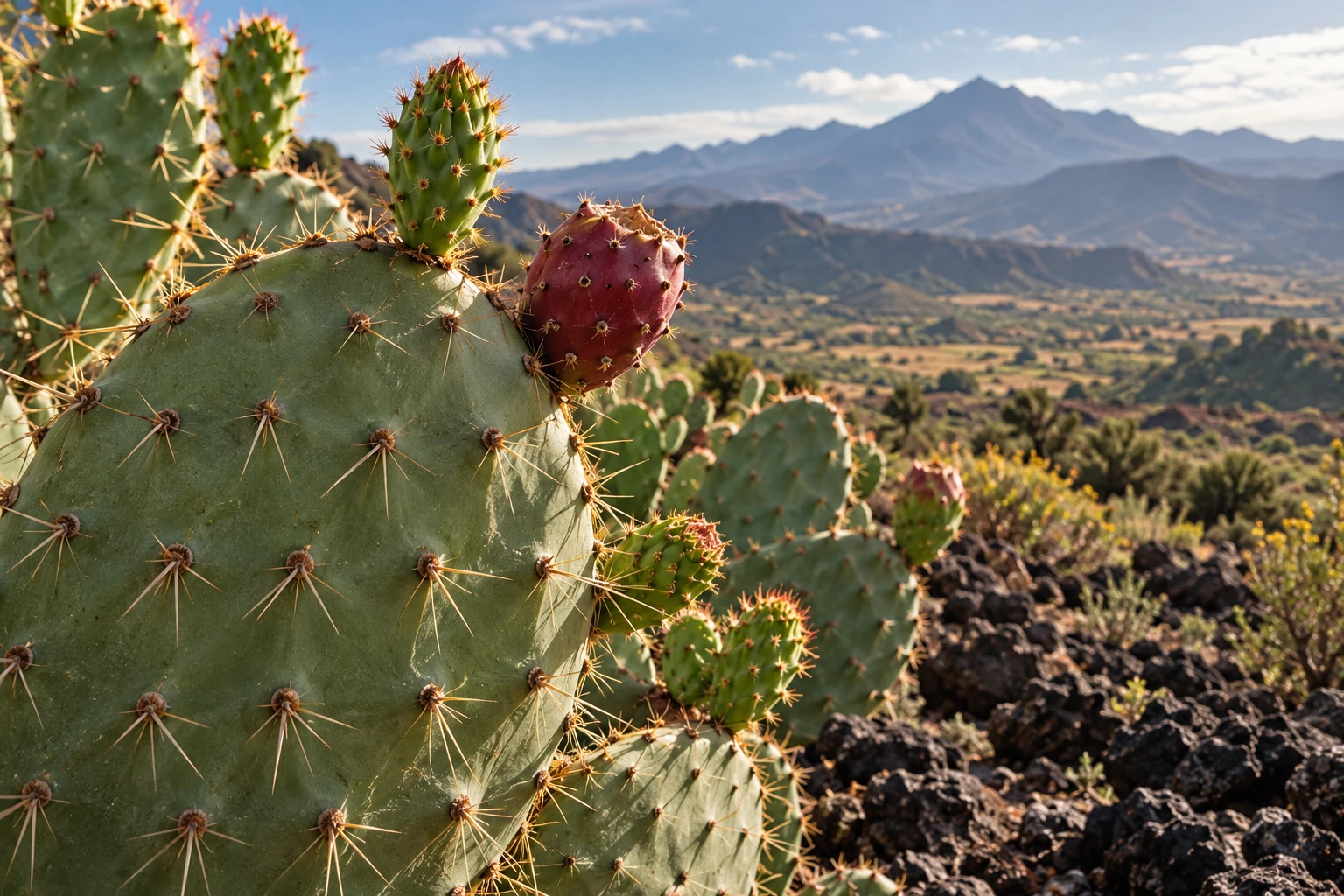
Our Nopal Grows High in the Mountains
The Opuntia streptacantha used for our flagship Natural Home Cures Freeze-Dried Nopal Powder Capsules grows on our own farms in the mountains of Mexico.
Our farms are located at approximately 2,500 meters—about 8,200 feet—above sea level, on a mountainside with rich volcanic soil and a mild, semi-tropical climate.
That growing environment matters because plants continually respond to the conditions around them.
Environmental Conditions and Phenolic Chemistry
Plant phenolic metabolism can respond to environmental factors such as light, ultraviolet exposure, temperature and water availability. (3), (4)
Research involving Opuntia grown at different elevations has found differences in phenolic profiles. (6)
Importantly, different compounds don't necessarily respond in exactly the same way.
So we're not saying altitude automatically increases every phenolic compound.
The more scientifically accurate—and more interesting—point is:
The environment in which a cactus grows can influence its natural chemistry.
Mountain Sunlight Above, Volcanic Soil Below
Picture one of our Opuntia streptacantha pads growing on the mountainside.
Above it:
Intense mountain sunlight.
Below it:
Rich volcanic soil.
Its roots interact with soil, water and available minerals.
Its pads interact with sunlight, temperature and the atmosphere.
Inside the plant, countless biochemical reactions continue every moment.
Phenolic compounds such as caffeic acid belong to that living chemical system.
Why Owning Our Farms Matters
Natural Home Cures owns the farms where the Nopal for our flagship capsules is grown.
That means our involvement begins before the cactus is harvested.
We know the species.
We know where it grows.
We know the elevation and growing environment.
We're connected to harvest.
And then we're connected to processing.
The journey remains continuous:
High-altitude mountain farm → rich volcanic soil → living Opuntia streptacantha → harvest → freeze-drying → Nopal powder → Natural Home Cures capsules.
For a whole-plant botanical product, we believe that connection matters.
Why We Don't Extract Caffeic Acid
Natural Home Cures doesn't isolate caffeic acid and sell it as a separate ingredient.
Our flagship capsules contain freeze-dried Nopal cactus.
Caffeic acid is one part of a much larger natural plant profile that can include fiber, amino acids, minerals, vitamins, pigments, flavonoids and other phenolic compounds.
Our interest isn't in presenting caffeic acid as a miracle molecule.
It's in understanding how this individual compound fits within the whole botanical matrix of Nopal cactus.
From One Phenolic Acid to Another
Caffeic acid gives us another useful way to understand plant chemistry.
Start with:
Phytonutrients.
Move into:
Polyphenols.
Then:
Phenolic acids.
And finally:
Caffeic acid.
But even there, the story doesn't stop.
Caffeic acid connects through plant metabolism with other phenolic compounds, including ferulic acid.
One branch keeps leading to another.
More Chemistry Hidden Inside a Green Cactus
That's what makes Nopal such an interesting plant to study.
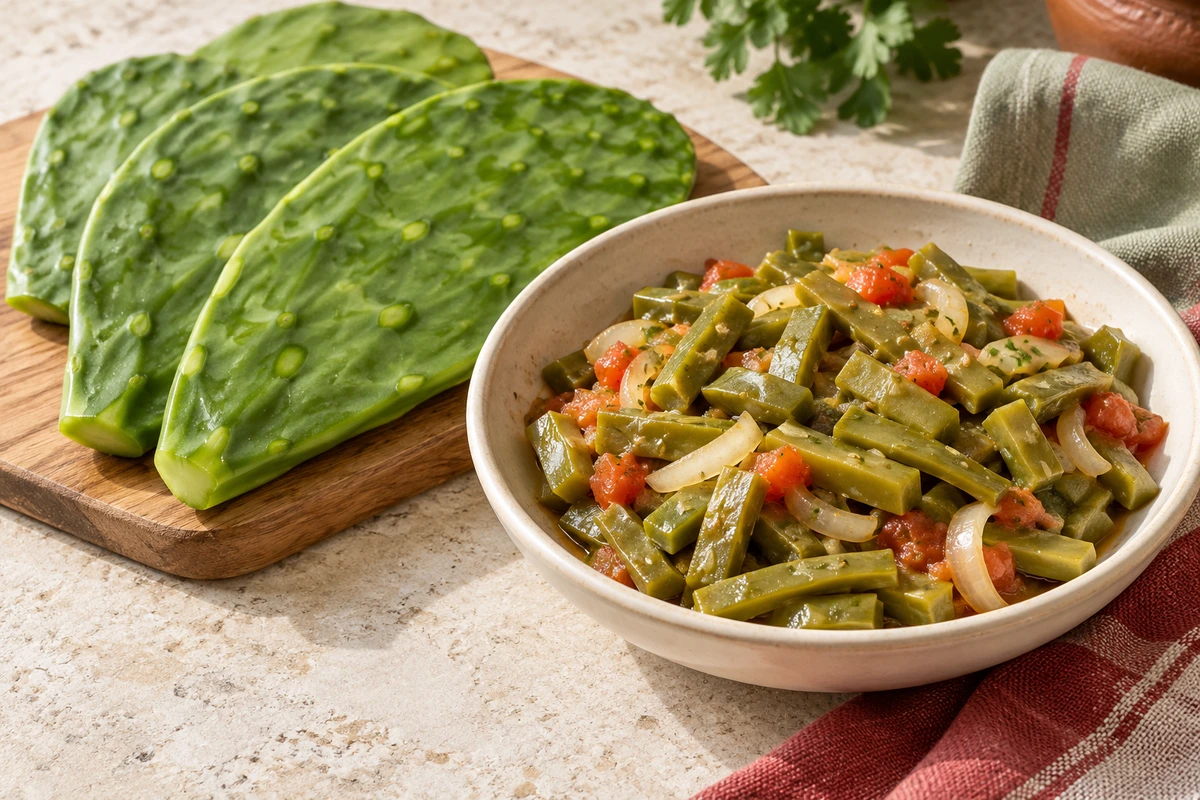
From the outside, a cactus pad can look simple.
Green.
Thick.
Covered with spines.
But inside it is a complicated biochemical system producing numerous families of natural compounds.
Caffeic acid is one of those compounds identified in Opuntia research. (1), (2)
For Natural Home Cures, it's another small piece of a much bigger story:
the living Opuntia streptacantha cactus growing high in the mountains of Mexico at the beginning of our flagship Freeze-Dried Nopal Powder Capsules.
And once again, the closer we look at Nopal, the more there is to discover.
FROM CACTUS TO PRODUCT
Keep the botanical
in the story.
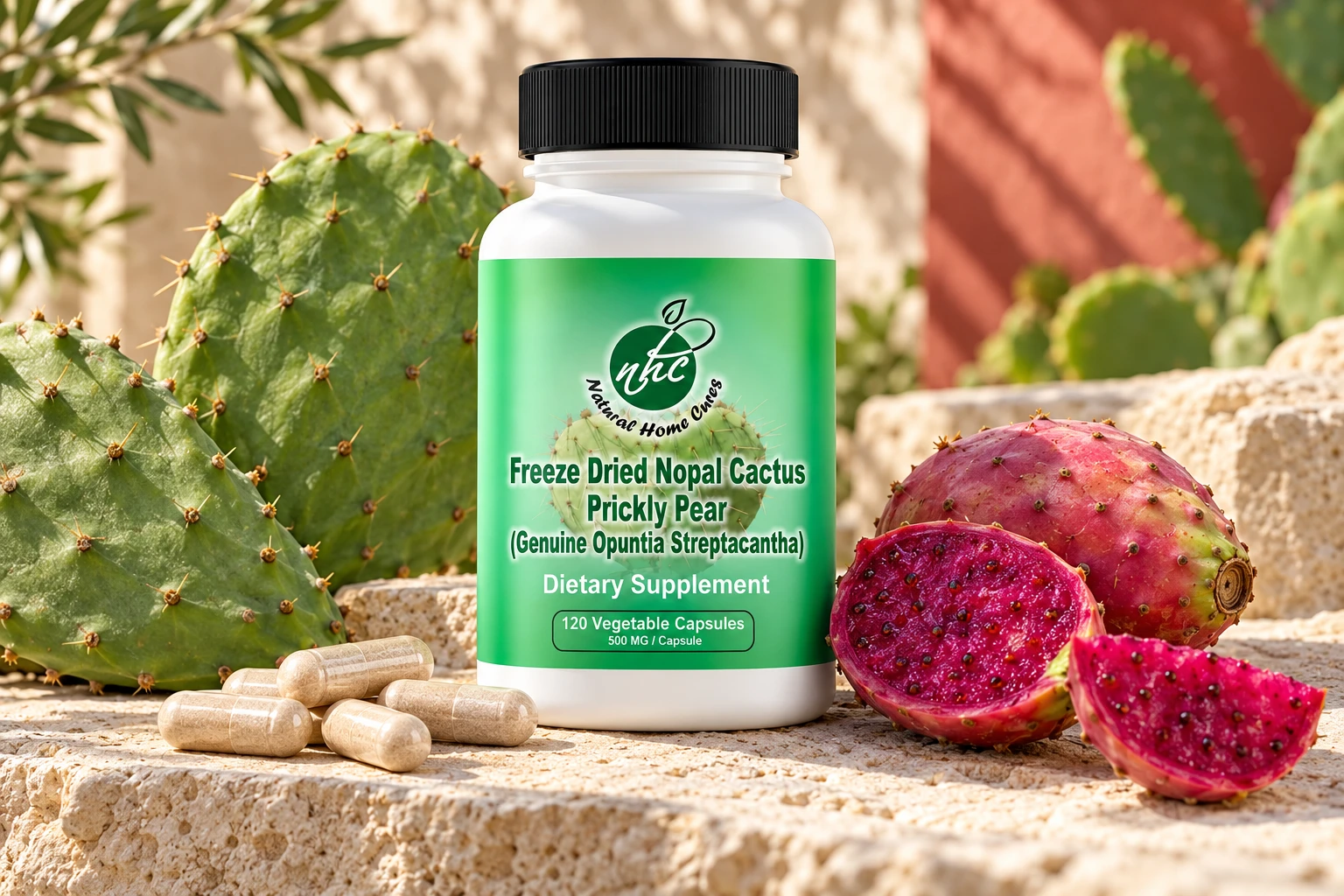
Freeze-dried Nopal cactus capsules.
Explore our Nopal →The research behind this articleSource References
- 01Research reviewStructure–Function Relationships and Health-Promoting Properties of the Main Nutraceuticals of the Cactus Pear (Opuntia spp.) Cladodes: A Review.View source
Full citation
Koufan M, Choukrane B, Mazri MA. “Structure–Function Relationships and Health-Promoting Properties of the Main Nutraceuticals of the Cactus Pear (Opuntia spp.) Cladodes: A Review.” Molecules. 2024;29(19):4732. - 02Research referenceProximate Composition, Phenolic Acids, and Flavonoids Characterization of Commercial and Wild Nopal (Opuntia spp.).View source
Full citation
Guevara-Figueroa T, Jiménez-Islas H, Reyes-Escogido ML, et al. “Proximate Composition, Phenolic Acids, and Flavonoids Characterization of Commercial and Wild Nopal (Opuntia spp.).” Journal of Food Composition and Analysis. 2010;23(6):525–532. - 03Research referencePhenylpropanoid Biosynthesis.View source
Full citation
Vogt T. “Phenylpropanoid Biosynthesis.” Molecular Plant. 2010;3(1):2–20. - 04Research referenceResponse of Phenylpropanoid Pathway and the Role of Polyphenols in Plants under Abiotic Stress.View source
Full citation
Sharma A, Shahzad B, Rehman A, et al. “Response of Phenylpropanoid Pathway and the Role of Polyphenols in Plants under Abiotic Stress.” Molecules. 2019;24(13):2452. - 05Research reviewCaffeic Acid: A Review of Its Potential Use in Medications and Cosmetics.View source
Full citation
Magnani C, Isaac VLB, Correa MA, Salgado HRN. “Caffeic Acid: A Review of Its Potential Use in Medications and Cosmetics.” Analytical Methods. 2014;6:3203–3210. - 06Research referenceEffect of Altitude on Polyphenolic Profile of ‘Dellahia’ Prickly Pear (Opuntia ficus-indica) Juice from Northern Morocco.View source
Full citation
Koalaga DY, Messaoudi Z, Ibriz M, Ait Haddou L. “Effect of Altitude on Polyphenolic Profile of ‘Dellahia’ Prickly Pear (Opuntia ficus-indica) Juice from Northern Morocco.” Journal of Biochemistry International. 2021;8(1):93–103.