Natural Home Cures · Growing & Harvesting
Mangosteen’s
Clandestine
Origins
Centuries of cultivation.
A beginning still debated.
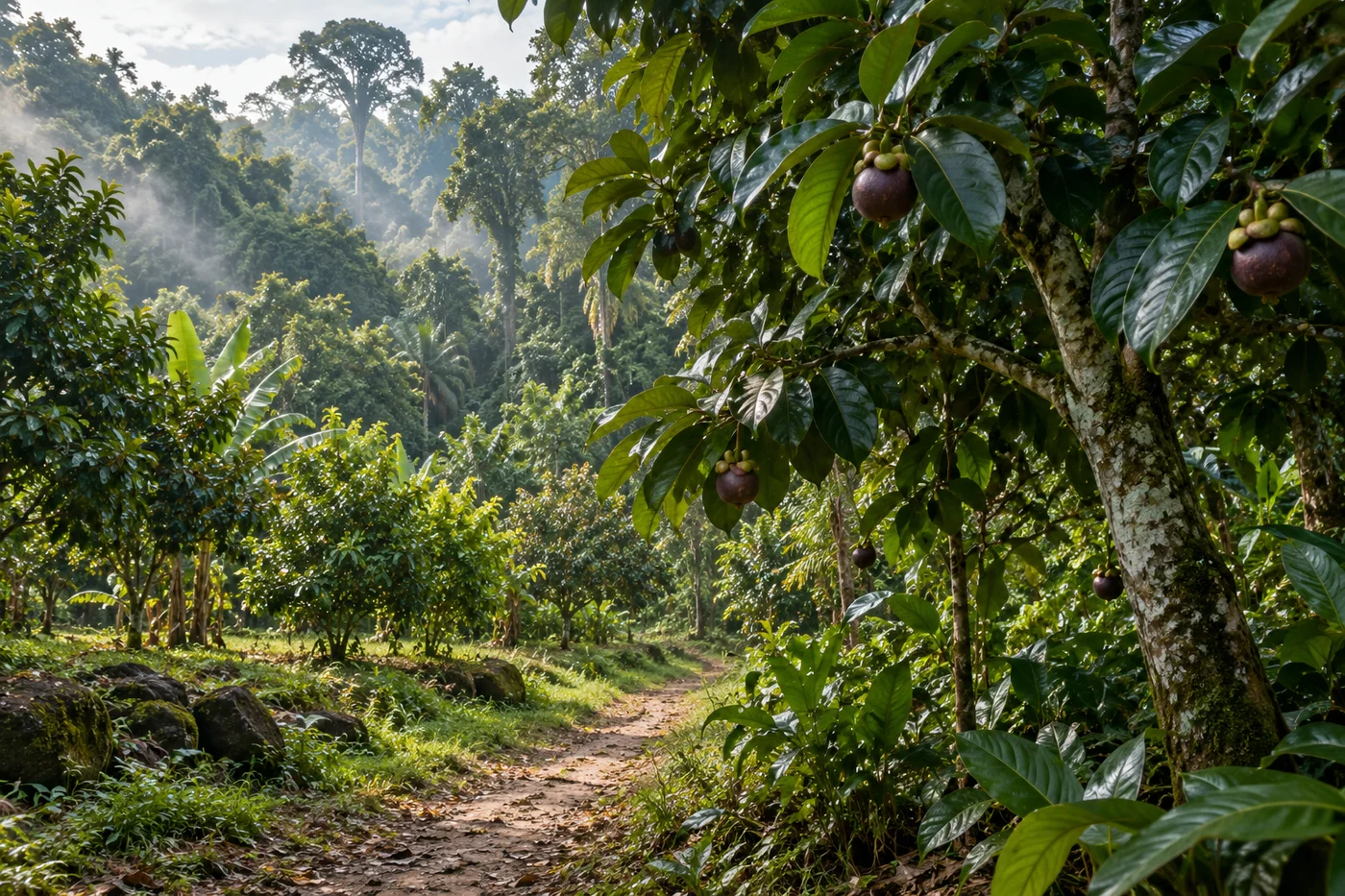
and orchard.Conceptual landscape—not a documented birthplace.
Mangosteen’s origins involve two questions: where its relatives occur, and how people helped shape the cultivated fruit. Separate the geographic record from the competing explanations, then follow the historical clues.
01 · What distribution records tell us
Where Mangosteen Is Native.
Where the Questions Begin.
The Royal Botanic Gardens, Kew, lists Garcinia mangostana as native to Peninsular Malaysia and Borneo, in the wet tropical biome.(2)
A species’ native range and the process that produced its cultivated form are separate research questions.
Peninsular
Malaysia
Borneo
These geographic labels describe the current species record. They do not pinpoint one domestication site.
To investigate cultivation, researchers look beyond present-day geography.
02 · Several lines of inquiry
How Researchers
Investigate the Origins.
Unusual reproduction and long human movement complicate the origin question. Researchers combine biological, specimen and historical evidence.(1)
Genetics
Chromosomes
Plant form
Herbarium specimens
Language
Historical records
These different clues help researchers test the older hybrid explanation against a single-progenitor interpretation.
03 · How the interpretation has changed
Which Wild Relative
Gave Rise to Mangosteen?
A two-parent hybrid?
This widely repeated proposal was questioned in the 2023 review.(1)
Names shown as used in the historical hypothesis.A single wild progenitor.
var. malaccensis
The authors favor this wild relative as the progenitor.(1) Kew accepts the variety and lists G. malaccensis as a synonym.(3)
The domestication pathway.
The exact process remains unresolved. A leading interpretation is not a complete origin story.
Identifying a likely ancestor is only part of the question. The next step is explaining how people may have selected and tended it.
04 · A proposed evolutionary framework
A Proposed Pathway
From Forest to Orchard.
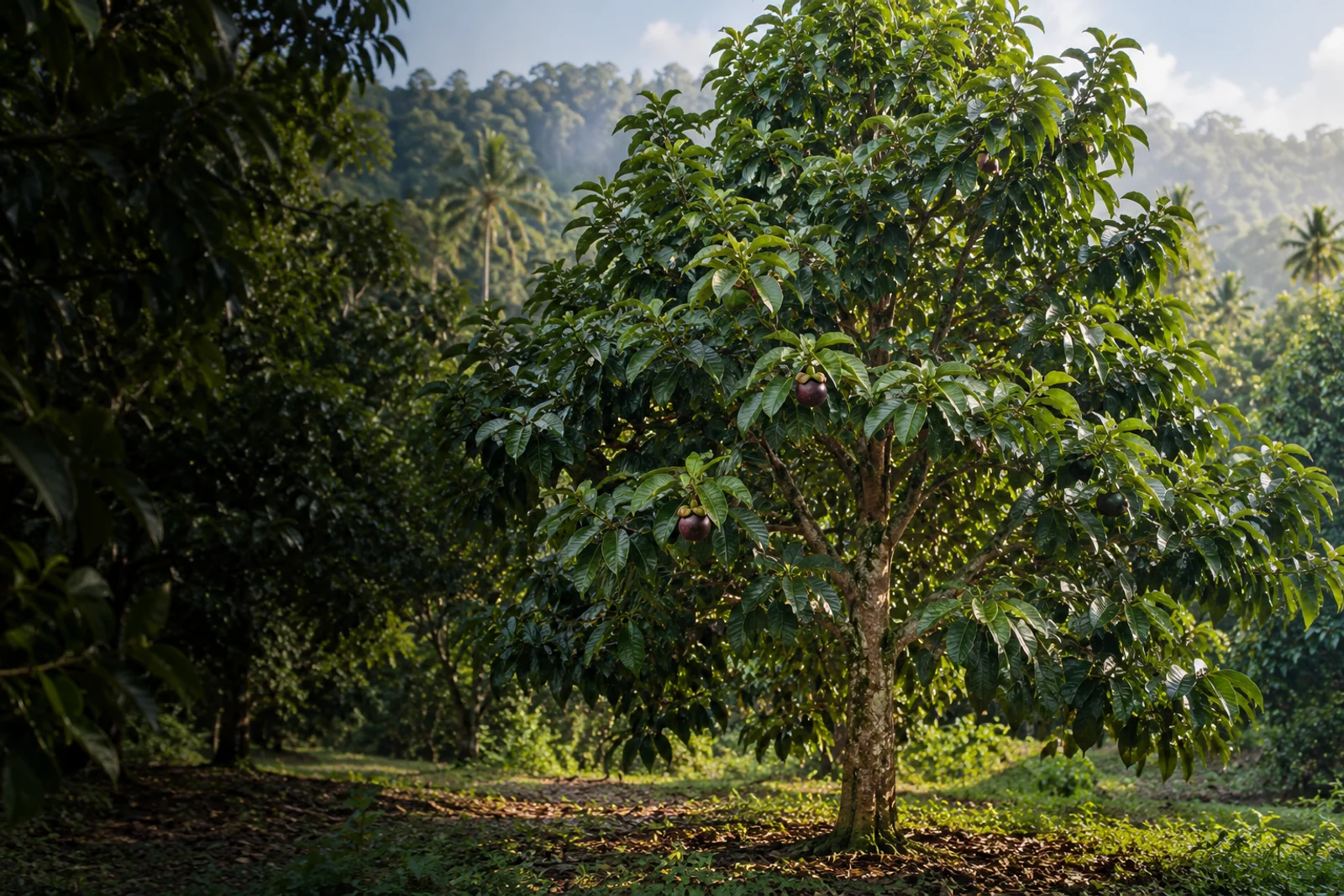
The review proposes selection where forest meets traditional mixed orchards, or dusun.(1)
A simplified proposed pathway—not a verified sequence of events.
Written records add another strand of evidence: the fruit was already moving through trading networks.
05 · Clues carried through trade
Trade Leaves Clues.
It Also Complicates the Trail.
Chinese records link mangosteen with a transliteration of manggis.(1)
European accounts record the fruit in trading regions.(1)
Historical movement adds clues, while making the original geographic trail harder to reconstruct.
06 · Keep the questions distinct
Separate Origins
From Growing Conditions.
Where and how
did domestication happen?
What conditions
help the tree grow?
Knowing the growing conditions helps orchard care. It does not, by itself, locate the beginnings of domestication.

07 · A botanical story worth understanding
From Living Tree
to Fruit Pericarp.
Our Freeze-Dried Rich Pericarp Mangosteen Capsules use the thick pericarp of Garcinia mangostana.
The history of that tree adds context to the botanical material we use.
Explore our mangosteen →The research behind this articleSource References
- 01Origin & domestication reviewThe origin of cultivated mangosteenView source ↗
Full citation
Yao TL, Nazre M, McKey D, Jalonen R, Duminil J. The origin of cultivated mangosteen (Garcinia mangostana L. var. mangostana): Critical assessments and an evolutionary-ecological perspective. Ecology and Evolution. 2023;13(3):e9792. doi:10.1002/ece3.9792.
- 02Species distributionGarcinia mangostana L.View source ↗
Full citation
Royal Botanic Gardens, Kew. Garcinia mangostana L. Plants of the World Online. Accepted species in Clusiaceae; native range Peninsular Malaysia and Borneo.
- 03Wild-relative taxonomyGarcinia mangostana var. malaccensisView source ↗
Full citation
Royal Botanic Gardens, Kew. Garcinia mangostana var. malaccensis (Hook.f.) Nazre. Plants of the World Online. Accepted variety; Garcinia malaccensis Hook.f. listed as a synonym.