Natural Home Cures · Mangosteen science
Other Xanthones
& Mangosteen
Explore the wider xanthone family found in mangosteen’s thick outer pericarp.
There is more to mangosteen than its two best-known xanthones. Beyond alpha and gamma lies a wider cast of compounds—and a growing collection of experiments asking what each one does.
Names such as gartanin and garcinone E may sound unfamiliar. Their research questions are easier to recognize: how do cells respond to inflammation, what controls cell growth, and how might a plant compound influence the systems that manage oxidative stress? This article follows those questions from the fruit pericarp to the laboratory, then into a small human absorption study.
Begin with the family
One Pericarp. A Much Wider Chemical Story.
Xanthones share a central chemical framework, but the groups attached to that framework vary. Those differences help explain why scientists identify and test individual compounds instead of treating every xanthone as interchangeable.(1)
A 2006 investigation separated fourteen xanthones from mangosteen pericarp, including gartanin, 8-deoxygartanin, garcinones D and E, and mangostinone. Separating a botanical extract into individual compounds lets researchers ask which molecule contributes to a particular laboratory response.(2)
Beta-mangostin, mangostinone and mangostingone are different names for different compounds. Similar spelling does not establish identical chemistry or activity. Some family members have detailed experimental studies; others appear mainly in work that identifies the fruit’s chemical constituents.(1), (2)
Chapter 01 / Signals & cell behavior
What changes inside the cell?
Start with inflammation, then follow the signals that help cells grow, recycle their contents and respond to stress.
2014 · Laboratory and mouse research · Beta-mangostin
Beta-mangostin and the inflammatory response
Inflammation is coordinated by chemical messages. A 2014 study examined whether beta-mangostin could alter some of those messages in mouse-derived immune cells called macrophages, and in a mouse model of inflammation.
The researchers stimulated the cultured cells with LPS, a substance commonly used to trigger an inflammatory response. Beta reduced the production of nitric oxide, prostaglandin E₂ and certain cytokines—small proteins that cells use to communicate. It also inhibited movement of NF-κB into the cell nucleus, where this signaling regulator can influence gene activity.
The animal results added nuance. Beta reduced the migration of white blood cells, particularly neutrophils, and lowered two inflammatory cytokines. It did not reduce vascular permeability, the leakage of fluid through blood-vessel walls, in that experiment.
The interesting finding is a pattern of effects across several parts of the response. These experiments help researchers investigate inflammation mechanisms; they did not test symptom relief or establish an effective oral dose for people.(3)
Measure what changes.
Cell experiments help isolate biological questions before they can be tested clinically.
2013 · Laboratory · Bladder cancer cell lines
Gartanin and the signals behind cell growth
Cells receive signals that help determine whether they grow, survive or dismantle damaged components. In a 2013 study, researchers investigated how gartanin affected human bladder cancer cells grown in the laboratory.
Gartanin inhibited growth across a panel of bladder cancer cell lines. In more detailed experiments, it changed proteins associated with mTOR, a signaling network involved in cell growth and resource use. Researchers also observed autophagy, the process through which a cell collects and recycles its own components.
The study found signs of apoptosis as well. Apoptosis is an organized cell-death process: a sequence of internal steps rather than a cell simply breaking apart. Changes involving p53 and Bcl-2 helped the researchers explore how that response occurred.
This gives gartanin a more specific research identity than a general “antioxidant” label. It appears capable of influencing several cellular systems under experimental conditions. The work concerns cultured cancer cells, however, and does not show that eating mangosteen prevents or treats bladder cancer.(4)
2013 · Laboratory · Melanoma cell line
8-Deoxygartanin: reading the cell’s instructions
A useful way to compare xanthones is to examine the instructions that treated cells are using. In a 2013 study, scientists compared alpha-mangostin, gamma-mangostin and 8-deoxygartanin in a human melanoma cell line called SK-MEL-28.
They measured messenger RNA, or mRNA. These molecules carry instructions that cells use to make proteins. Changes in mRNA offer clues about how a compound may affect the machinery involved in growth and survival, although they do not by themselves prove a clinical effect.
With 8-deoxygartanin, the researchers found increased mRNA for p21, a regulator involved in restraining cell-cycle progression, and decreased mRNA for cyclin D1 and NF-κB. Cyclin D1 helps regulate movement through the cell cycle; NF-κB participates in signaling linked to survival and inflammation.
The compounds produced overlapping but distinct patterns. That comparison matters: a result for alpha or gamma cannot simply be assigned to every related xanthone. This was a mechanistic study in cultured melanoma cells, not a trial of a skin-health supplement.(5)
Chapter 02 / Stress & cellular defenses
Different compounds. Different experimental questions.
Garcinone research explores cell stress and movement; antioxidant research asks how cells mobilize their own defenses.
2017 · Laboratory · Ovarian cancer cell lines
Garcinone E and a cell under stress
In 2017, scientists isolated twenty-four xanthones from mangosteen pericarp and screened their effects on ovarian cancer cells. Garcinone E stood out for further investigation.
It inhibited proliferation—the multiplication of cells—in several ovarian cancer cell lines, including a Taxol-resistant line. Tests also showed apoptosis and stress in the endoplasmic reticulum, the cellular system that helps process proteins. When protein processing becomes disrupted, cells activate stress-response pathways that may help them survive or contribute to cell death.
The researchers examined movement as well as growth. Garcinone E reduced migration and invasion in the tested cells, alongside changes in proteins associated with those behaviors. Laboratory migration and invasion assays explore how cells move; they do not establish that a compound prevents metastasis in people.
The study is interesting because it connects a named xanthone with several measurable cell responses. It also shows why the experimental setting matters: isolated garcinone E applied to cultured cells is a different exposure from consuming whole mangosteen pericarp.(6)
2026 · Laboratory · Mouse-derived macrophages
Garcinones C and D: inflammation meets cellular defense
Research on the wider family is continuing. A 2026 study investigated mangosteen pericarp and leaf tinctures and examined individual compounds, including garcinones C and D, in mouse-derived macrophages.
After the cells were challenged with LPS, both garcinones reduced nitric oxide production and expression of iNOS, an enzyme involved in producing that signaling molecule during an inflammatory response.
The researchers also examined Nrf2. This protein helps regulate genes involved in cellular antioxidant defenses. Garcinones C and D promoted movement of Nrf2 into the nucleus and increased the expression of several enzymes associated with that defense system.
The connection is useful to understand: researchers were studying both inflammatory activity and the cell’s own protective response. That is more informative than assuming “antioxidant” means only that a compound directly neutralizes a reactive molecule. These are laboratory findings for particular compounds and tinctures, not evidence that a capsule produces the same response in people.(7)
2023 · Computer modeling and cell experiments
Demethylcalabaxanthone and the antioxidant-response switch
One less familiar member of the family is demethylcalabaxanthone. A 2023 study compared several mangosteen xanthones using computer modeling and biological experiments to investigate antioxidant activity.
The researchers focused in part on the relationship between Keap1 and Nrf2. Keap1 helps regulate Nrf2; when that regulation changes, Nrf2 can help activate genes involved in a cell’s response to oxidative stress. Think of it as investigating a control system, rather than simply counting how many reactive molecules a compound can neutralize.
Their findings supported demethylcalabaxanthone as a candidate for influencing the Keap1–Nrf2 system. Computer docking suggested how the molecule might interact with a protein, while cell experiments supplied biological observations. A predicted fit from a computer model and a response in cells provide different kinds of evidence.
This research broadens the mangosteen story beyond alpha and gamma. It identifies another molecule worth investigating, without establishing benefits for memory, nerve health or any condition in people.(8)
One small study of absorption and metabolism
2012 · Mangosteen juice with a mealHuman research · Absorption and metabolism
What reaches the body after consumption?
A compound can show activity in a dish and still behave differently after it is swallowed. Digestion, absorption and metabolism determine what reaches the circulation and in what form.
A 2012 study followed ten healthy adults who consumed 60 mL of mangosteen juice with a high-fat breakfast. Researchers collected blood and urine to investigate xanthone absorption and the chemical changes that followed consumption.
The work found evidence of absorbed xanthones and of conjugation: the attachment of chemical groups as the body processes a compound. These modified forms can differ from the original molecules placed directly onto cells in laboratory experiments. Responses also varied between participants.
This is an important bridge between botanical chemistry and human research, but it answers an exposure question. It did not test whether the lesser-known xanthones improved a disease, and the juice preparation cannot establish the effects or dose of a different capsule product.(9)
Bring the story together
A family of research questions—not one interchangeable ingredient.
The wider xanthone family makes mangosteen scientifically interesting because its members can be separated, compared and tested. Beta-mangostin has inflammation research; gartanin has cell-signaling studies; garcinone E has detailed work on cultured cancer cells; other compounds are being examined for antioxidant-response mechanisms.(3), (4), (6)
Whole pericarp brings a mixture of plant constituents together. That botanical context matters, but a mixture should not be assumed to reproduce every result reported for an isolated molecule. Nor does the presence of several compounds, by itself, prove that they work synergistically.(1)
The most useful way to read each study is to keep three things in view: which compound or preparation was tested, which biological system was used, and what was actually measured. Those details turn a collection of unfamiliar names into a research story you can follow.
07 · From fruit to product
From Mangosteen Pericarp
to Natural Home Cures
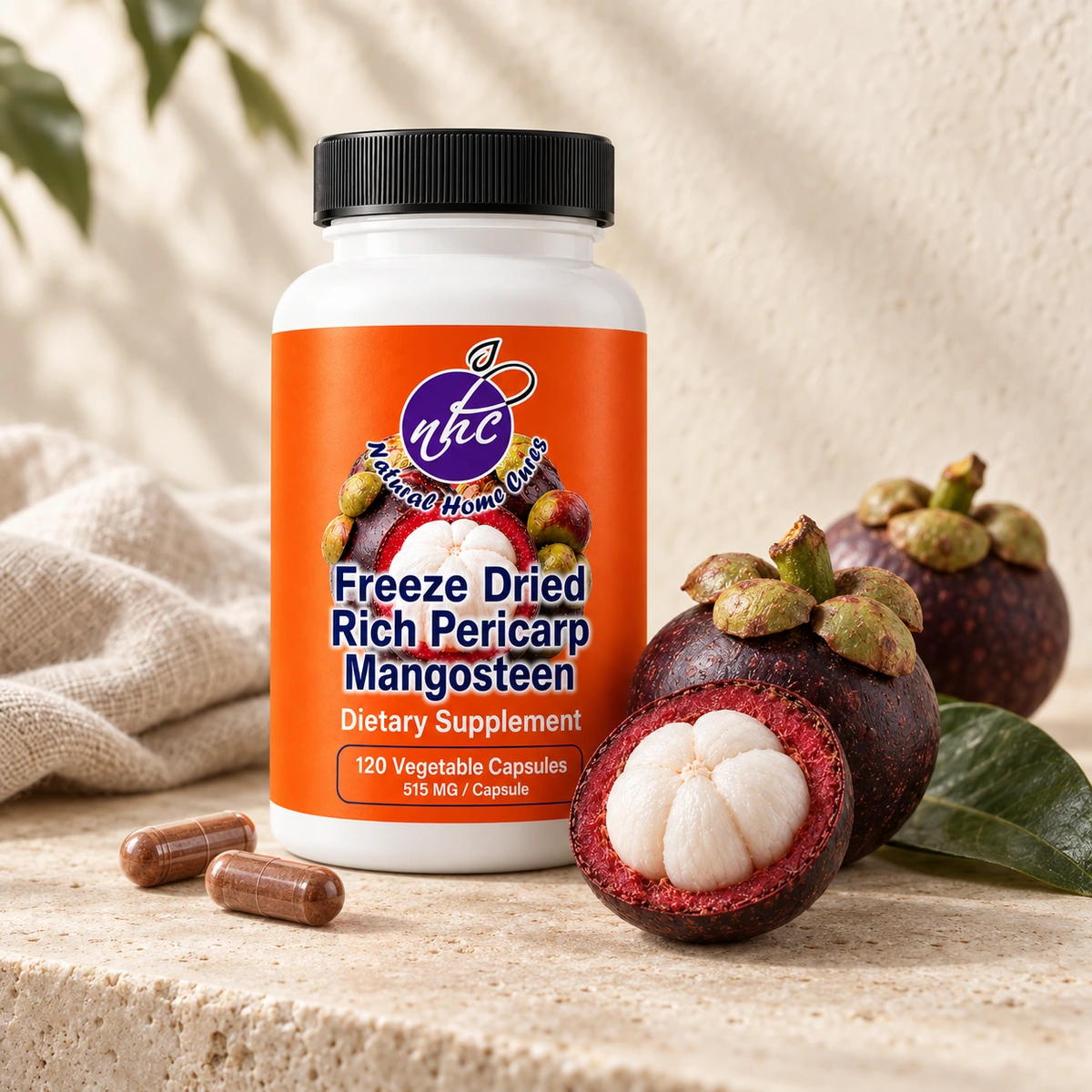
Our Freeze-Dried Rich Pericarp Mangosteen Capsules begin with the thick outer pericarp of Garcinia mangostana.
After harvest, the pericarp is freeze-dried and prepared for capsules. It remains whole botanical material, with a broader composition than one purified xanthone.
Explore our mangosteen →120 vegetable capsules · 515 mg of botanical material per capsule.
This is a whole-pericarp amount, not a measured amount of individual xanthones.The research behind this articleSource References
- 01Review · 2013Biological Activities and Bioavailability of Mangosteen Xanthones: A Critical Review of the Current EvidenceView source ↗
- 02Compound isolation · 2006Antioxidant Xanthones from the Pericarp of Garcinia mangostana (Mangosteen)View source ↗
- 03Laboratory and animal study · 2014β Mangostin suppress LPS-induced inflammatory response in RAW 264.7 macrophages in vitro and carrageenan-induced peritonitis in vivoView source ↗
- 04Laboratory study · 2013The effect of gartanin, a naturally occurring xanthone in mangosteen juice, on the mTOR pathway, autophagy, apoptosis, and the growth of human urinary bladder cancer cell linesView source ↗
- 05Laboratory study · 2013Altered mRNA Expression Related to the Apoptotic Effect of Three Xanthones on Human Melanoma SK-MEL-28 Cell LineView source ↗
- 06Laboratory study · 2017Garcinone E induces apoptosis and inhibits migration and invasion in ovarian cancer cellsView source ↗
- 07Laboratory study · 2026Mangosteen (Garcinia mangostana) Pericarp and Leaf Tinctures Inhibit LPS-Induced Pro-Inflammatory Responses in Macrophages and Activate Nrf2View source ↗
- 08Modeling and laboratory study · 2023Demethylcalabaxanthone from Garcinia mangostana Exerts Antioxidant Effects through the Activation of the Nrf2 Pathway as Assessed via Molecular Docking and Biological EvaluationView source ↗
- 09Human absorption study · 2012Xanthones in Mangosteen Juice Are Absorbed and Partially Conjugated by Healthy AdultsView source ↗