Natural Home Cures · Mangosteen science
ORAC Values
& Mangosteen
ORAC stands for Oxygen Radical Absorbance Capacity.
Start with what the ORAC assay measures, look at a published mangosteen result, then separate laboratory findings from evidence in people.
ORAC is a laboratory test of how well a sample delays oxidation of a fluorescent probe by peroxyl radicals. It allows researchers to compare foods and plant extracts under defined test conditions.(1), (2)
01 / INSIDE THE ASSAY
How ORAC Works
Follow the assay—from the oxidation challenge to a standardized comparison.
01
The oxidation challenge
In a typical ORAC assay, peroxyl radicals are generated in the laboratory and allowed to attack a fluorescent probe.
02
The antioxidant response
If antioxidants are present in the test sample, they delay the loss of fluorescence. Researchers compare that protection with Trolox, a water-soluble vitamin E analogue used as a standard.(2)
03
The reference standard
Results are therefore usually expressed as Trolox equivalents rather than as a direct amount of one particular antioxidant.
02 / A PUBLISHED FINDING
20.18
µmol Trolox equivalents / gram
Garcinia mangostana
Aqueous plant extract · 2017 study
Study reference(3)
What One Mangosteen Study Measured
A 2017 study of aqueous pigmented plant extracts reported an ORAC value of 20.18 micromoles of Trolox-equivalent antioxidant capacity per gram for the Garcinia mangostana sample, which was higher than the other plant extracts compared in that experiment.(3)
A newer ORAC review also tabulates raw mangosteen among foods with measurable peroxyl-radical-scavenging capacity.(2)
03 / THE ESSENTIAL DISTINCTION
How to Interpret an ORAC Result
LABORATORY MEASUREMENT
Antioxidant capacity
≠
HUMAN EVIDENCE
Clinical benefit
The key distinction is between a laboratory measurement and evidence of an effect in people.
A high ORAC result means a sample performed strongly in a particular laboratory oxidation test. It does not mean the same number of radicals will be neutralized inside the human body, and it does not prove that one food will produce greater health benefits than another.
A major review of total antioxidant-capacity testing specifically warns that treating a food's laboratory antioxidant-capacity value as a direct measure of health benefit is erroneous.(4)
04 / READING THE EVIDENCE
Why ORAC Became So Popular
Foods contain many different antioxidant compounds, so measuring every molecule individually can be difficult.
ORAC offered a convenient way to ask a broader laboratory question: how much peroxyl-radical-scavenging capacity does this sample show under the conditions of the assay?
The USDA once published a large database of food ORAC values, which helped popularize the idea of comparing foods by a single antioxidant-capacity number.(1)
Why the USDA Database Was Withdrawn
The USDA's ORAC database was widely quoted by food and supplement marketers.
Later, USDA withdrew the database because ORAC values were being interpreted as though they predicted the effects of foods and polyphenols inside the human body. Modern reviews repeat the USDA's concern that in-vitro antioxidant-capacity numbers do not directly establish human health effects.(2)
The ORAC assay itself did not disappear. Researchers still use it as an analytical tool. What changed was the idea that an ORAC ranking should be used as a simple consumer health ranking.
What About Human Studies?
Some studies have measured ORAC in human blood after people consumed mangosteen-containing products.(5)
One study reported an increase in plasma ORAC after a xanthone-rich beverage, but that beverage also contained ingredients such as aloe vera, green tea and added vitamins.(5)
That makes the result interesting but prevents us from assigning the entire effect specifically to mangosteen.
What ORAC Can Still Tell Us
ORAC remains useful when it is used for the question it was designed to answer.
It can compare antioxidant capacity under defined laboratory conditions, help researchers study extraction methods and provide one piece of information about complex plant materials.(2)
It should be considered alongside other assays, chemical composition, absorption, metabolism and—most importantly—human evidence.
THE TAKEAWAY
What the Number Can Tell You
ORAC helped scientists create a common language for one type of antioxidant-capacity testing.
Mangosteen performs well in several antioxidant assays, including ORAC, but the responsible interpretation is straightforward: the number describes laboratory chemistry.
It is useful science when kept in context—and misleading when turned into a shortcut for predicting human health.
05 / THE PRODUCT CONTEXT
From Mangosteen Pericarp to Natural Home Cures
Mangosteen pericarp contains xanthones, phenolic compounds, pigments and other plant constituents that can contribute to laboratory antioxidant measurements.
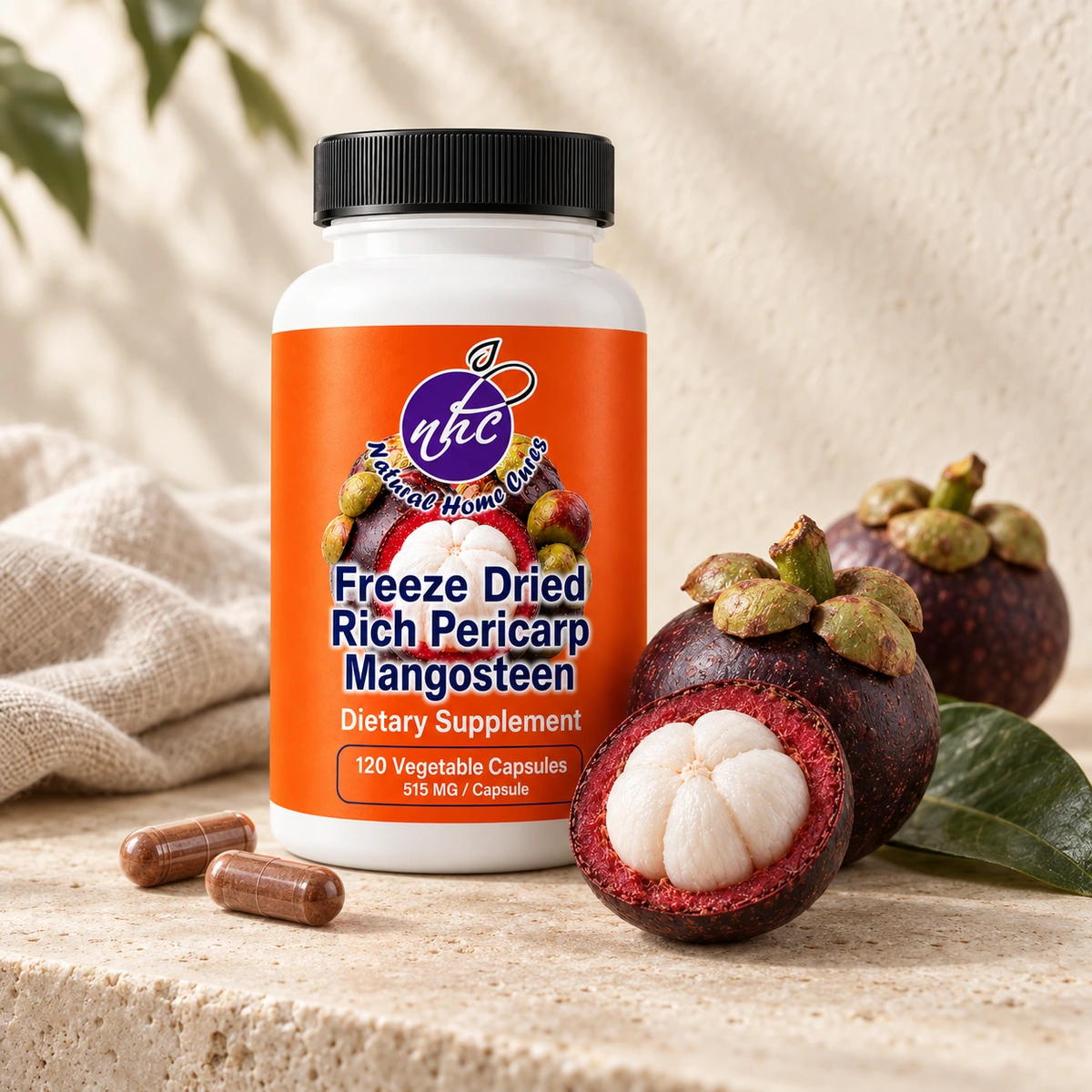
At Natural Home Cures, we do not treat an ORAC number from a published fruit or extract as the guaranteed ORAC value of our Freeze-Dried Rich Pericarp Mangosteen Capsules.
A quantitative ORAC claim about these capsules requires direct testing of the finished product under a defined method.
The research behind this articleSource References
- 01Research referenceUSDA Database for the Oxygen Radical Absorbance Capacity (ORAC) of Selected Foods.View source
Full citation
(1) Bhagwat SA, Haytowitz DB, Holden JM. “USDA Database for the Oxygen Radical Absorbance Capacity (ORAC) of Selected Foods.” USDA Agricultural Research Service. 2007. — View source ↗
- 02Research referenceORAC: The Method of Choice for Determining Antioxidant Capacity of Food Products?View source
Full citation
(2) Sadowska-Bartosz I, Bartosz G. “ORAC: The Method of Choice for Determining Antioxidant Capacity of Food Products?” International Journal of Molecular Sciences. 2026;27(11):4825. — View source ↗
- 03Research referencePhenolics, antioxidants and color properties of aqueous pigmented plant extracts: Ardisia colorata var. elliptica, Clitoria ternatea, Garcinia mangostana and Syzygium cumini.View source
Full citation
(3) Siti Azima AM, Noriham A, Manshoor N. “Phenolics, antioxidants and color properties of aqueous pigmented plant extracts: Ardisia colorata var. elliptica, Clitoria ternatea, Garcinia mangostana and Syzygium cumini.” Journal of Functional Foods. 2017;38:232–241. — View source ↗
- 04Research referenceTwenty-five years of total antioxidant capacity measurement of foods and biological fluids: merits and limitations.View source
Full citation
(4) Pellegrini N, Vitaglione P, Granato D, Fogliano V. “Twenty-five years of total antioxidant capacity measurement of foods and biological fluids: merits and limitations.” Journal of the Science of Food and Agriculture. 2020;100(14):5064–5078. — View source ↗
- 05Research referenceBioavailability and antioxidant effects of a xanthone-rich Mangosteen (Garcinia mangostana) product in humans.View source
Full citation
(5) Kondo M, Zhang L, Ji H, Kou Y, Ou B. “Bioavailability and antioxidant effects of a xanthone-rich Mangosteen (Garcinia mangostana) product in humans.” Journal of Agricultural and Food Chemistry. 2009;57(19):8788–8792. — View source ↗