Natural Home Cures · A botanical storybook
The History & Folklore of Mangosteen
A Queen, a Quest
& a Purple Crown
Follow a little purple fruit through tropical gardens,
across distant seas, and into a royal tale.
Botany, travel & a royal rumor
Born in the wet tropics of Southeast Asia, the mangosteen drew admirers long before Europeans wrote about it. Growers treasured it at home, while visitors struggled to describe its flavor or carry it across oceans. What followed is a mix of botany, travel, and a royal rumor worth unpacking.
Chapter I · Before the palace
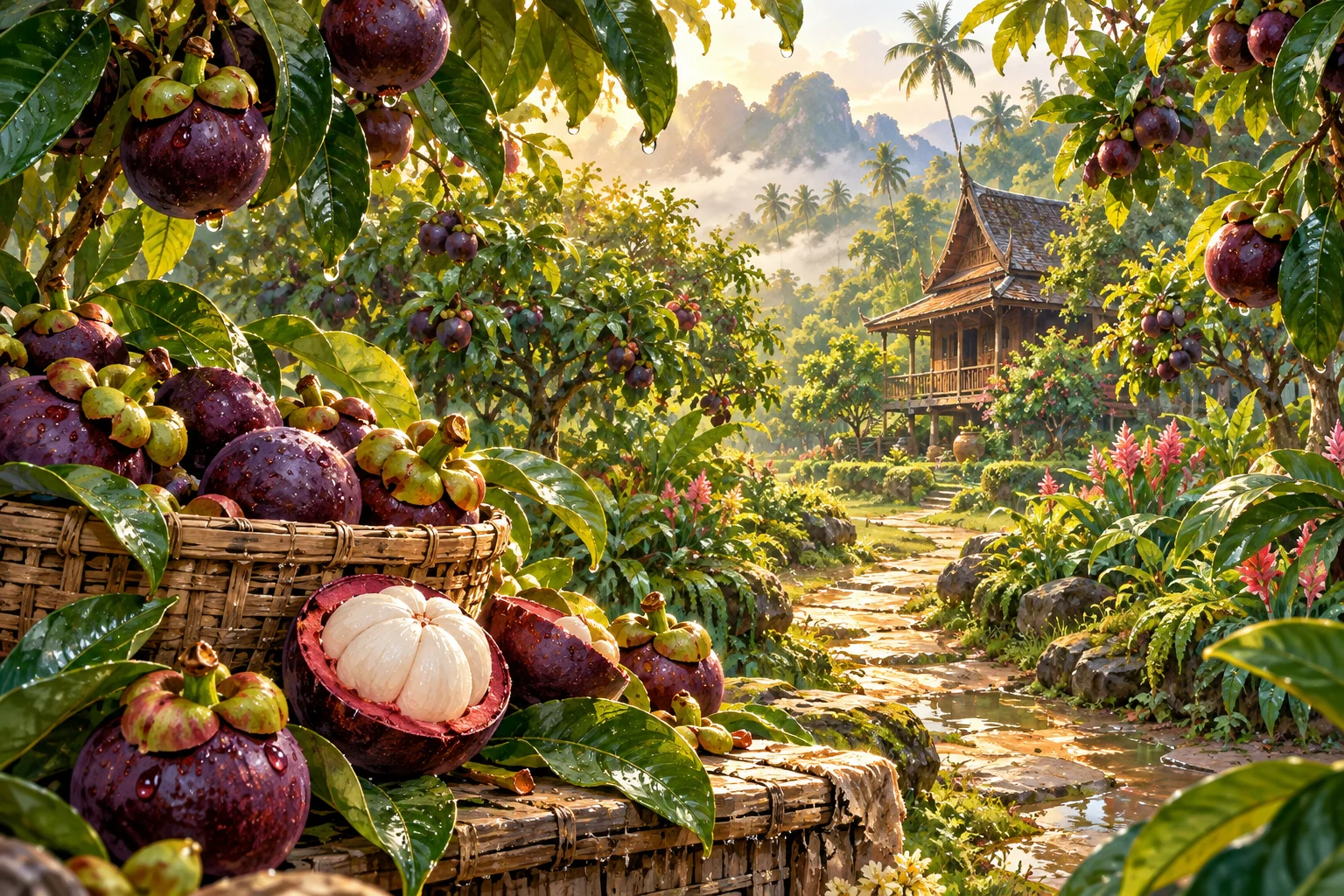
Home, among the leaves
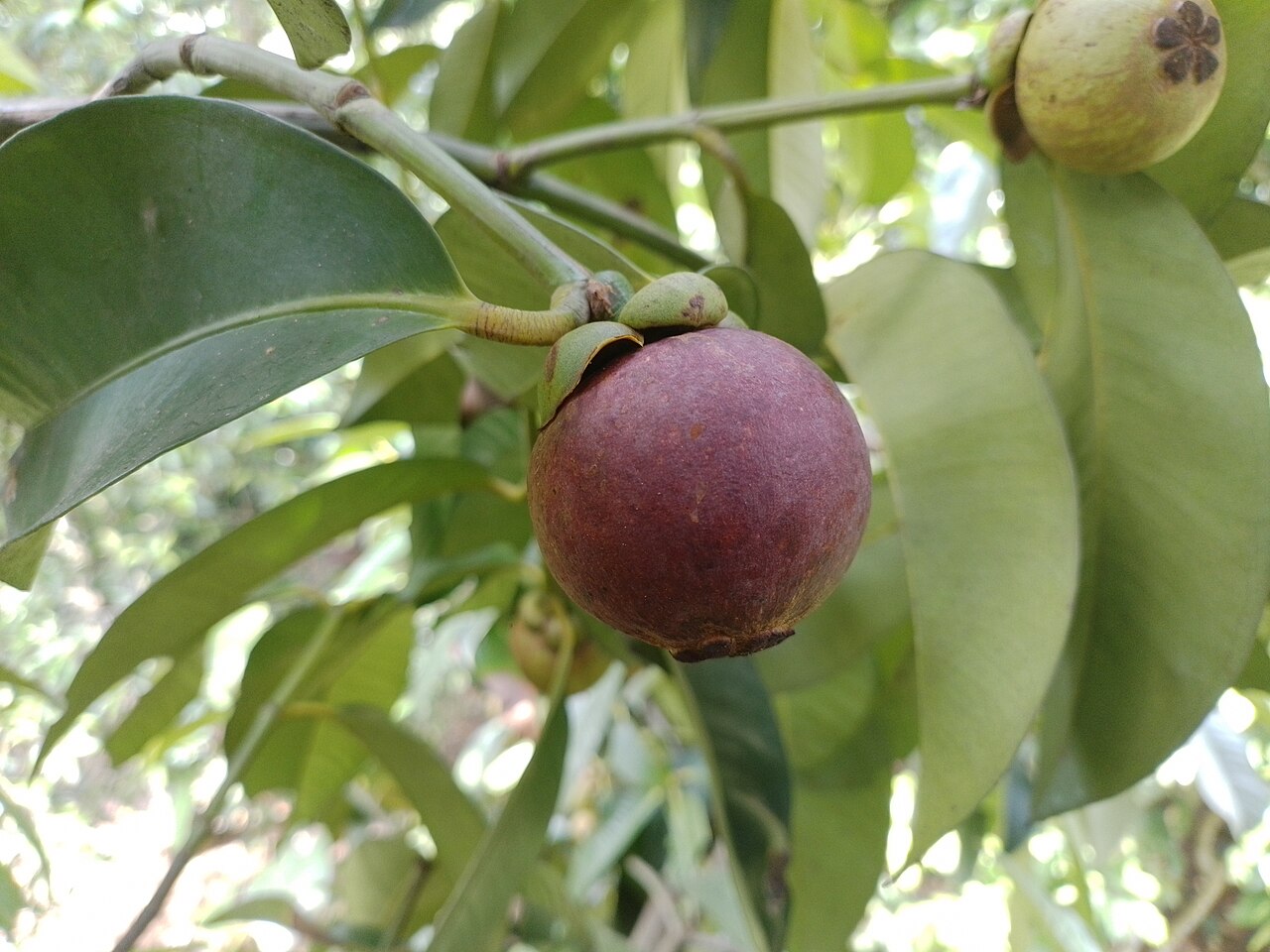
The mangosteen’s story begins in the wet tropics of Southeast Asia. Kew’s botanical record lists its native range as Peninsular Malaysia and Borneo, placing its roots among the warm, rain-fed landscapes where the tree belongs.1
It is easy to let the later royal stories steal the scene. But long before a European gardener tried to grow a mangosteen under glass, people in Southeast Asia knew the pleasure of opening its thick purple rind and finding the white segments inside. The fruit already had a home and people who valued it.
Picture an orchard after rain: water gathering at the tips of glossy leaves, ripe fruit among the branches, and an opened mangosteen revealing a striking contrast of purple and white. That simple encounter helps explain the fascination that runs through the accounts we will meet along the way.
As word of the fruit reached readers farther afield, admiration came with a practical question. How could something enjoyed fresh in a tropical garden be brought to a place with a very different climate? Answering that question would take the story from the orchard to the printed page, and from there toward the sea.
Chapter II · The journey begins
Across the seas,
with a garden to protect
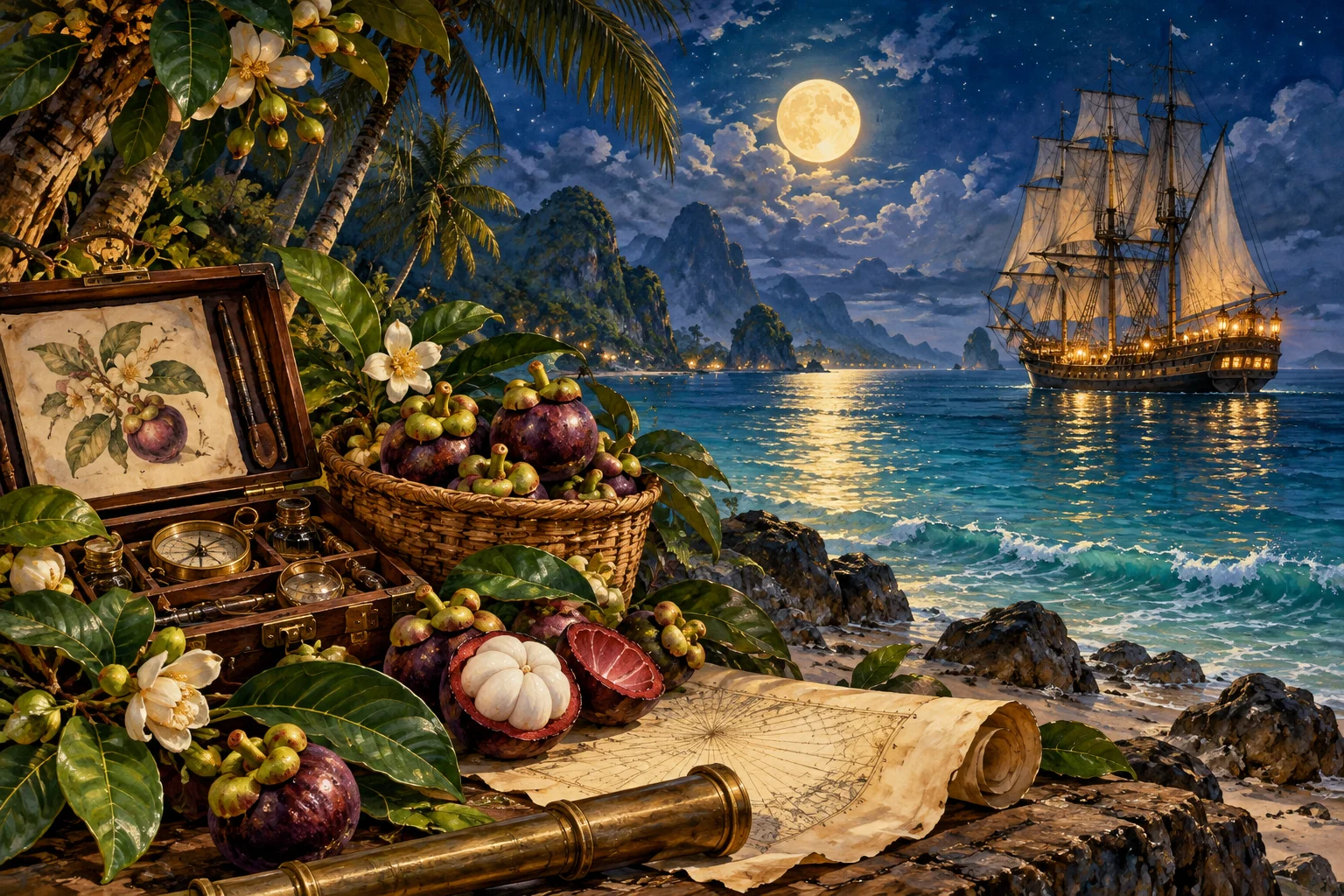
By 1775, the mangosteen had found its way into a publication with travelers very much in mind. The naturalist John Ellis devoted a book to mangosteen and breadfruit, pairing descriptions of the plants with directions for voyagers transporting them. The title celebrated the mangosteen’s deliciousness and breadfruit’s usefulness: two different reasons to carry a tropical plant across an ocean.3
The directions are a reminder that enthusiasm alone could not make the journey succeed. Taking a living plant aboard a ship meant thinking about its care throughout the voyage. Moving the fruit itself raised another difficulty: the taste that inspired such admiration belonged to fresh fruit, and a long passage stood between the orchard and the person waiting at the other end.
There is something wonderfully human about the ambition. Anyone who has tasted something extraordinary while traveling will recognize the wish to bring it home. In the eighteenth century, however, that wish could become a gardening problem stretching across thousands of miles of water.
Ellis’s book does not give us one continuous adventure to follow from departure to arrival. What it does show is that people were thinking seriously about how to move these plants. The mangosteen was becoming both a botanical subject and a practical challenge.
Getting a tree to another shore was only part of that challenge. Once it arrived, someone still had to provide the conditions in which it could grow—and, with considerable patience, perhaps produce fruit of its own.
Chapter III · An orchard under glass
A tropical guest
in an English garden
In England, that ambition brought the mangosteen into a setting far removed from its tropical home. A glasshouse offered gardeners a way to shelter a warmth-loving tree while an English garden carried on outside. The contrast gives this chapter much of its charm: the same plant, with a very different world beyond its leaves.
At Syon Park in 1855, gardener John Ivison succeeded in bringing mangosteen to fruit under glass, according to the historical account cited below. It was a remarkable result for a tree so closely associated with tropical growing conditions.4
Pause over what that achievement meant. Describing a delicious fruit in a book was one thing; tending a living tree until it produced that fruit in England was quite another. The gardener’s part in the story depended on observation, care, and the willingness to keep working toward a result that could not be hurried.
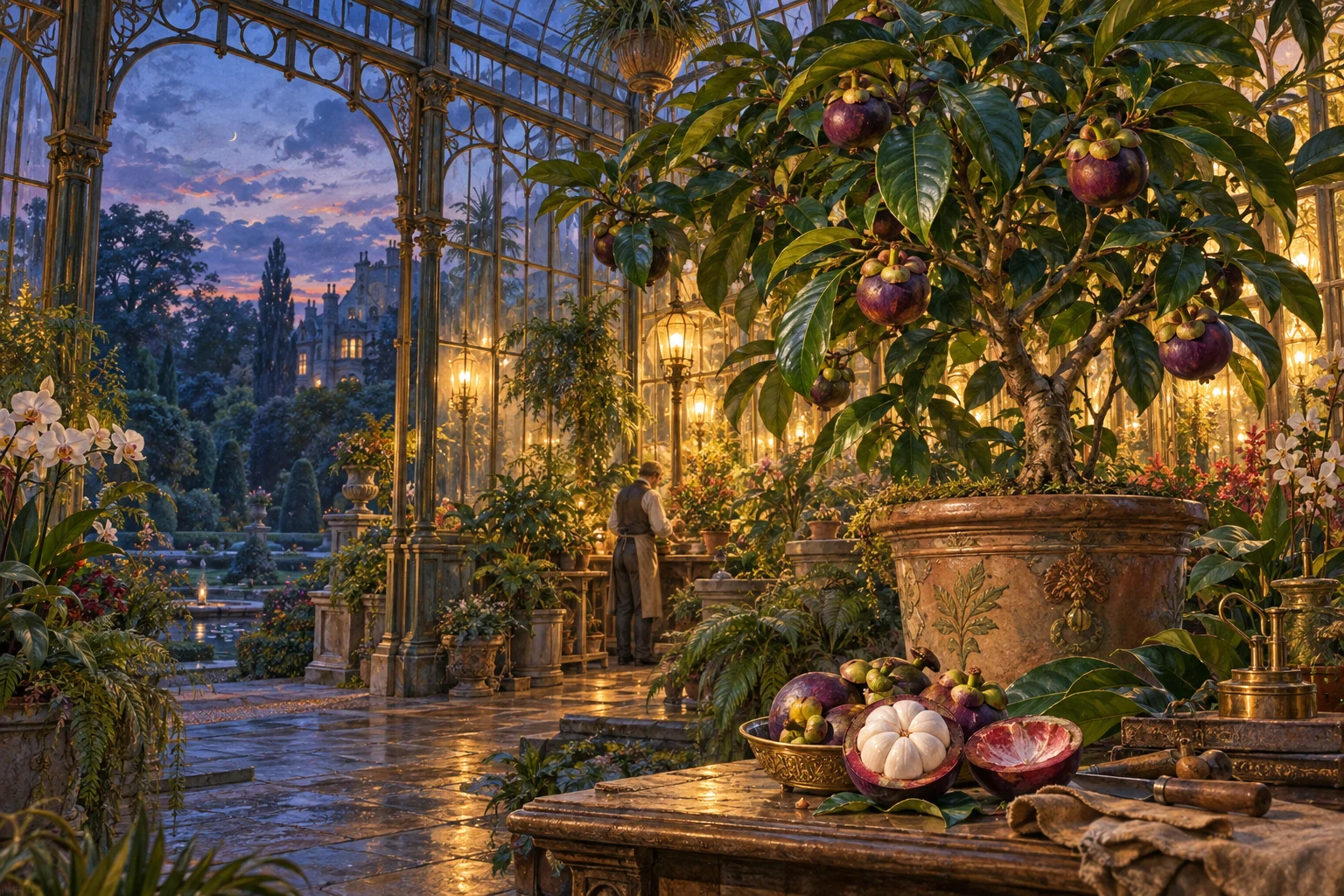
Our illustration imagines the atmosphere of such a glasshouse, with warm light inside and evening gathering beyond the panes. It is an artist’s interpretation, rather than a picture of Ivison’s actual tree, but it captures the appeal of making a small tropical refuge within an English landscape.
The Syon Park episode gives the journey a tangible milestone. The fruit that had prompted instructions for voyagers could also reward a gardener’s persistence. Yet for most distant readers, the next best thing to tasting a mangosteen was still a traveler’s account—and those accounts could be delicious reading.
Chapter IV · A taste worth describing
A flavor that borrowed
the whole fruit bowl
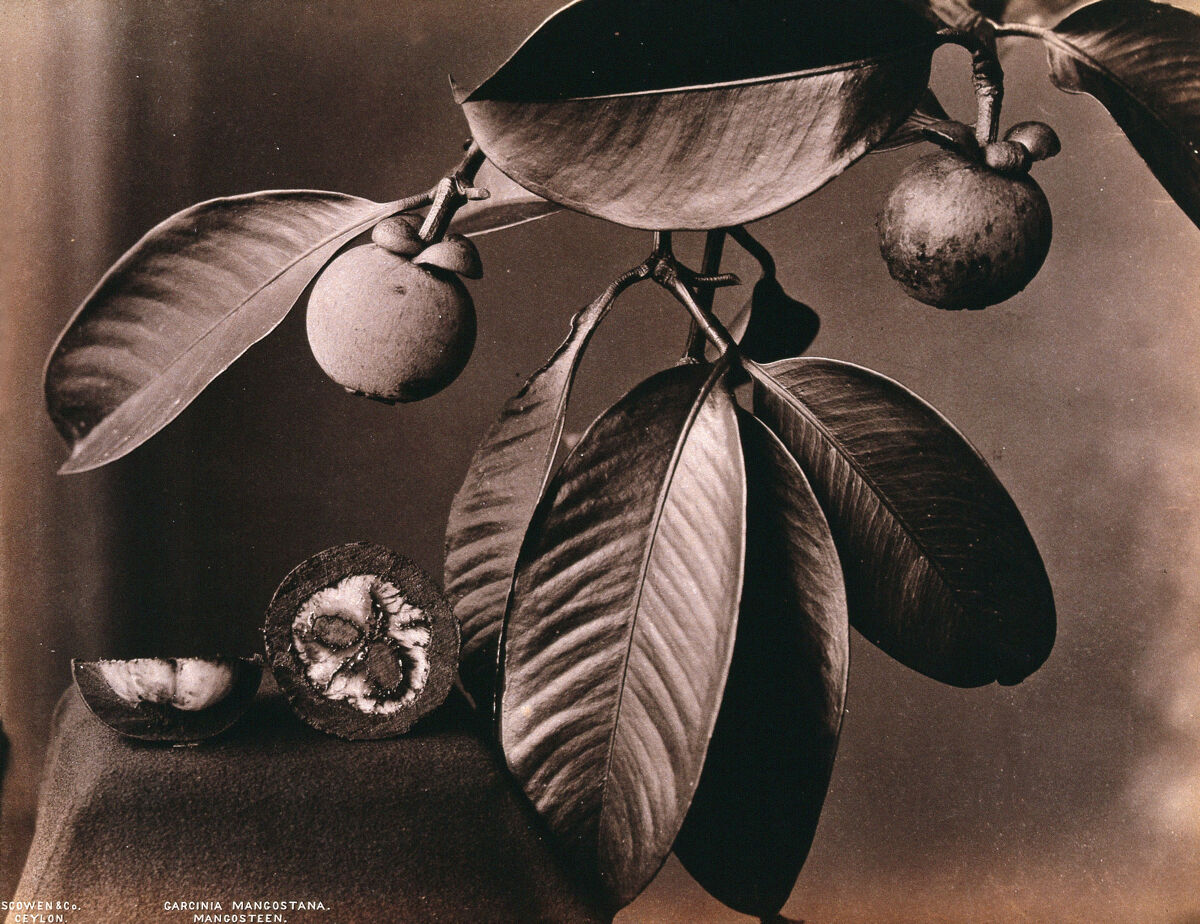
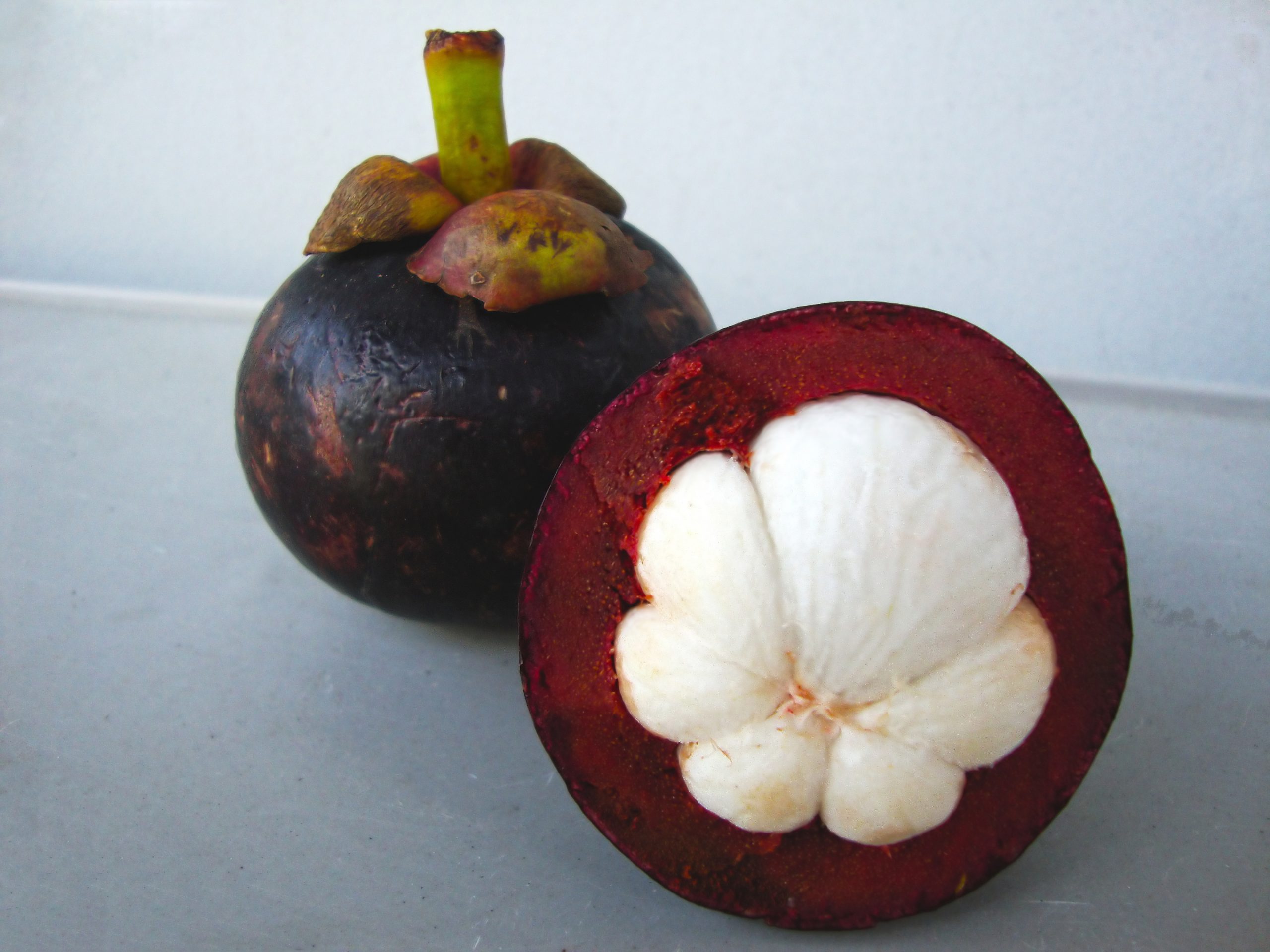
Twenty-five years after the Syon Park fruiting, Frederick William Burbidge offered readers an especially tempting description in his 1880 travel book, The Gardens of the Sun. Writing about the fresh white flesh, he reached for the flavor of a fine nectarine touched by strawberry and pineapple.2
One familiar fruit apparently would not do. The comparison draws on several at once, giving readers who had never seen a mangosteen something to imagine. Even then, a description could only go so far. There remained the pleasure of opening the rind, separating a soft segment, and discovering how closely the taste matched the promise.
Burbidge also noticed something beyond the edible flesh. In the bazaars, he described dried mangosteen skins threaded on rattan. It is a small but memorable observation, bringing the rind into view as part of the fruit’s wider history.2
For our journey, the distinction matters. The white flesh belongs to the story of fresh-fruit flavor; the purple rind, or pericarp, has a botanical history of its own. They are parts of the same fruit, but a traveler’s enthusiasm for the taste of the flesh should be read as exactly that.
Accounts like Burbidge’s help us understand why mangosteen became such an inviting subject for storytelling. It was beautiful to look at, difficult to describe, and challenging to enjoy far from where it grew. Add a royal admirer to that combination, and it is easy to see the appeal of the legend that follows.
Chapter V · History meets folklore
A queen, a fruit,
and a very tempting rumor
The best-known mangosteen legend brings Queen Victoria into the story. In a familiar version, she offered £100 to anyone who could bring her a fresh mangosteen. Other tellings make the prize grander still, replacing the money with a knighthood.
It is a compelling tale because the difficulty is already familiar. We have followed the problem of carrying tropical plants across the sea and seen the care involved in producing fruit under glass. Against that background, a queen offering a reward for a rare taste feels like a splendid next chapter.
But a story that fits beautifully is not automatically a documented event. The historical research cited below notes that David Fairchild repeated the £100 account in his 1930 book Exploring for Plants; it has not established a contemporary record confirming that Victoria offered the reward.4
That leaves us with a royal legend worth enjoying as folklore. We cannot place an announcement on a particular palace wall, name a successful claimant, or say that a knighthood was awarded for delivering the fruit. Those details would turn an appealing rumor into a history we cannot support.
The uncertainty also leaves an interesting question. If the reward cannot be confirmed, does the entire connection between Victoria and mangosteen disappear with it? Fortunately, it does not. Beyond the frequently repeated legend lies a quieter account preserved in Kew’s archive history—and that account brings actual fruit to the queen.
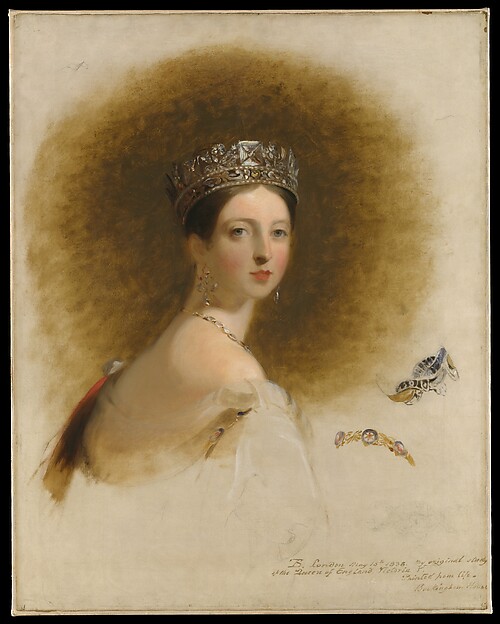
The reward belongs to legend.
The royal shipment belongs to the record.
Chapter VI · The documented arrival
At last, the royal table
To follow that firmer trail, we return to the nineteenth century and shift our attention to Trinidad. Kew’s Archives team records a successful shipment of mangosteens to England in 1875 under Henry Prestoe. The ocean crossing that had posed such a challenge was possible.5
The same archive account records that, in 1891, mangosteens from Trinidad were presented to Queen Victoria by Governor Sir Frederick Napier Broome. Here the story reaches the queen through a documented presentation, giving the royal connection a foundation beyond the reward legend.5
The two stories are easy to blend, but keeping them distinct makes the history more interesting. A shipment reaching Victoria does not prove that she had offered £100 or a knighthood for it. It does give us a real event to set beside the folklore: fruit grown far from its Southeast Asian roots, carried onward, and presented to a British queen.
There is one more royal thread to untangle. Mangosteen is widely known as the Queen of Fruits, and Fairchild used that name in the title of a 1915 article. That documents the nickname’s use by then; it does not tell us who first coined it or establish that Victoria bestowed it.6
Perhaps that is an appropriate ending to the royal chapter. The nickname expresses admiration, the reward supplies a memorable legend, and the archive preserves the presentation. Together they explain the fascination without requiring every part of the tale to carry the same weight as evidence.
Chapter VII · Every good journey brings us home
Back to the orchard
After the ocean crossings, the English glasshouse, and the royal presentation, the story leads us back to the orchard. The mangosteen’s appeal began with the tree and the people who knew its fruit, long before it acquired an English gardening milestone or a place in royal folklore.
Following that journey gives familiar details a little more depth. An opened fruit recalls the travelers searching for words to describe its flavor. A living tree brings to mind the care needed to grow it in unfamiliar surroundings. Even the nickname Queen of Fruits carries a history that is richer than a single explanation.
At Natural Home Cures, that curiosity is part of getting to know the fruit behind our capsules. Our interest centers on its purple pericarp, carefully freeze-dried. The fresh white flesh has its own culinary story; the preparation of the pericarp is a different part of our mangosteen collection, which you can explore through the links below.
For now, the history leaves us with something pleasantly simple: a fruit that inspired people to write, grow, travel, and tell stories. Some of those stories can be followed through books and archives. Others remain folklore, polished by repetition and made a little more splendid with each telling.
If you have the chance to open a fresh mangosteen, you may find the fascination easy to understand. Beneath that deep purple rind is the taste so many travelers tried to put into words—and the beginning of the journey we have just followed.
The end of this tale.
The beginning of your curiosity.
For the curious readerThe books behind the story
1. Royal Botanic Gardens, Kew. Garcinia mangostana — Plants of the World Online. Native range and botanical record.
2. Frederick William Burbidge · 1880. The Gardens of the Sun, Chapter XV, pp. 310–312. Firsthand historical descriptions of the fruit, flavor and dried rind. Historical observations are presented in their period context.
3. John Ellis · 1775. A Description of the Mangostan and the Bread-fruit. Digitized historical publication and directions for voyagers, held by the Wellcome Library.
4. Panoramic Fruit Company. The History and Folklore of the Mangosteen. Research into the Syon Park fruiting and Queen Victoria reward legend; includes references to David Fairchild’s Exploring for Plants (1930). The reward remains unverified.
5. Kat Harrington · Kew Archives · 2018. Happy 200th birthday to the Royal Botanic Gardens, Trinidad. The “Fit for a Queen” section records shipments in 1875 and presentation to Queen Victoria in 1891.
6. David Fairchild · 1915. The Mangosteen: “Queen of Fruits”. Journal of Heredity 6(8), 339–347. Documents use of the nickname; does not prove its first origin.
A note on the pictures: The orchard, voyage, glasshouse, and writing-table scenes are original imaginative storybook artwork. The fruit photographs, Wellcome archival photograph, and Thomas Sully portrait are identified in their captions. The artwork evokes the tale; it is not a record of a particular voyage or royal visit.